
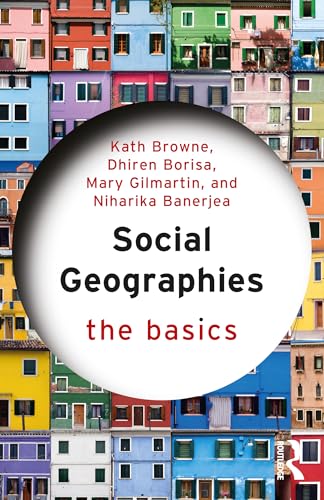
Social geographies the basics
Material type: TextPublication details: London Routledge 2024Edition: 1stDescription: x,189p. Includes bibliographical references and indexISBN:
 - 9781032211251
- U475 R4
 Textbook
| Cover image | Item type | Current library | Home library | Collection | Shelving location | Call number | Materials specified | Vol info | URL | Copy number | Status | Notes | Date due | Barcode | Item holds | Item hold queue priority | Course reserves | |
|---|---|---|---|---|---|---|---|---|---|---|---|---|---|---|---|---|---|---|
|
Textbook
|
Ratan Tata Library | Ratan Tata Library | U475 R4 (Browse shelf(Opens below)) | Available | RT1528292 |
This book approaches social geographies by beginning with the resistances, contestations and ‘solutions’ that communities use to challenge exclusions in place and space in order to create equitable societies. It then addresses the inequalities, precarities, and ‘problems’ that prompt these interventions. This allows the book to emphasise the importance of activism in the here and now, and to show how activism often makes issues visible and contested in ways that are then theorised by academics. Social Geographies starts with solidarities, communities, and networks before moving to examine difference, precarity, and mobilities. Each chapter offers key case studies that centre resistance, contestations of inequitable power, and local knowledges that can often be seen as ‘solutions’ to national and transnational issues, creating a decolonial understanding of ‘social geography from below’ within and across national contexts.
There are no comments on this title.