
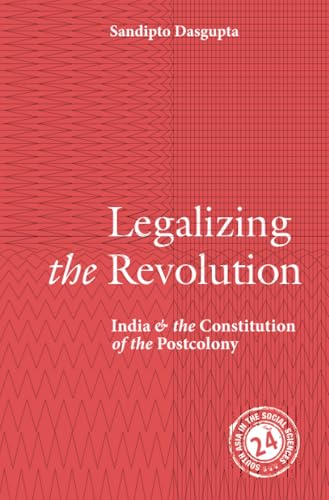
Legalizing he Revolution: India& the constitution of the postcolony
Material type: TextPublication details: United Kingdom Cambridge University Press 2024Description: xvii, 490p. Includes notes and indexISBN:
 - 9781009525244
- Y9(W6).2.N R4
 Textbook
| Cover image | Item type | Current library | Home library | Collection | Shelving location | Call number | Materials specified | Vol info | URL | Copy number | Status | Notes | Date due | Barcode | Item holds | Item hold queue priority | Course reserves | |
|---|---|---|---|---|---|---|---|---|---|---|---|---|---|---|---|---|---|---|
|
Textbook
|
Ratan Tata Library | Ratan Tata Library | Y9(W6).2.N R4 (Browse shelf(Opens below)) | Available | RT1585265 |
Anticolonial movements of the twentieth century generated ambitious ideas of freedom. Following decolonization, the challenge was to give an institutional form to those ideas. Through an original account of India's constitution making, Legalizing the Revolution explores the promises, challenges, and contradictions of that task. In contrast to derived templates, Dasgupta theorizes the distinctively postcolonial constitution through an innovative synthesis of the history of decolonization and constitutional theory. The book traces the contentious transition from the tumult of popular anticolonial politics to the ordered calculus of postcolonial governance; and then explains how major institutions – parliament, judiciary, rights, property – were formed by that foundational tension. A major contribution to postcolonial political theory, the book excavates the unrealized futures of decolonization. At the same time, through a critical account of the making of the postcolonial constitutional order, it offers keys to understanding the present crisis of that order, including and especially in India.
There are no comments on this title.