
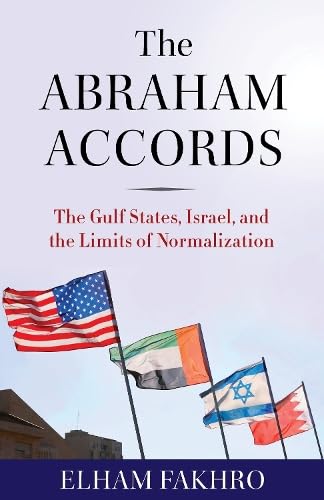
Abraham Accords : The Gulf states, Israel, and the limits of normalization
Material type: TextLanguage: English Publisher: 2024Description: x, 335p. cmContent type:
 - text
- unmediated
- volume
- 9780231212380
- Abraham Accords (2020 September 15)
- Israel -- Foreign relations -- Law and legislation
- National security -- Law and legislation -- Israel
- Peace treaties
- Israel -- Foreign relations -- United Arab Emirates
- United Arab Emirates -- Foreign relations -- Israel
- Israel -- Foreign relations -- Bahrain
- Bahrain -- Foreign relations -- Israel
- V46:19 R4
 Textbook
| Cover image | Item type | Current library | Home library | Collection | Shelving location | Call number | Materials specified | Vol info | URL | Copy number | Status | Notes | Date due | Barcode | Item holds | Item hold queue priority | Course reserves | |
|---|---|---|---|---|---|---|---|---|---|---|---|---|---|---|---|---|---|---|
|
Textbook
|
Arts Library | Arts Library | V46:19 R4 (Browse shelf(Opens below)) | Available | AL1804292 |
Includes bibliographical references and index.
A promised land -- A new generation of Gulf leaders -- The Trump Administration -- A new relationship -- Tolerance-washing -- Peace and its discontents.
"On August 13, 2020, then President Donald Trump delivered a groundbreaking announcement: his administration had brokered a peace agreement between Israel and the United Arab Emirates. Weeks later, the president triumphantly announced that Bahrain had followed suit. At a ceremony held on the South Lawn of the White House, foreign ministers from the two Gulf states joined Trump and Israeli Prime Minister Benjamin Netanyahu in signing the Abraham Accords, a treaty that outlined their shared intent to establish a new era of peace and opportunity in the Middle East. The Abraham Accords marked the first peace agreement between Israel and an Arab state in over twenty-five years, and the first ever between Israel and any of the Gulf monarchies. Still in their infancy, the Abraham Accords have upended the Middle East's political landscape and shattered the Arab consensus around the Palestinian issue. The book explores three questions: Why did the Accords happen? How were they orchestrated? And what do they mean both for the parties involved and for the party most visibly excluded from the arrangement: the Palestinians? Elham Fakhro takes a bottom-up approach, looking at the perspectives of civic actors in the United Arab Emirates, Bahrain, and Saudi Arabia to understand how shared security concerns with Israel, interest in global trade, and a desire for ties to the West led these countries to overlook a longtime solidarity with Palestinians, whose voices Fakhro also includes. She also looks at the new directions that Palestinian activists and politicians will need to take in the wake of these growing alliances"-- Provided by publisher.
There are no comments on this title.