
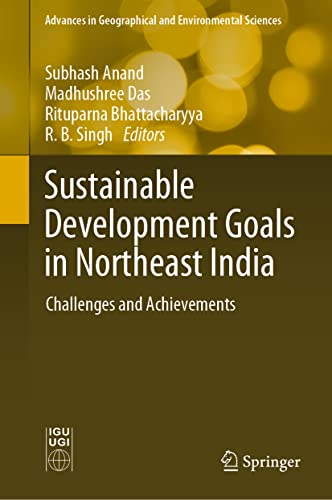
Sustainable development goals in northeast India: Challenges and achievement
Material type: TextPublication details: Singapore Springer 2023Description: xvi, 594 p. : ill. Includes bibliographical references & IndexISBN:
 - 9789811964770
 Textbook
| Cover image | Item type | Current library | Home library | Collection | Shelving location | Call number | Materials specified | Vol info | URL | Copy number | Status | Notes | Date due | Barcode | Item holds | Item hold queue priority | Course reserves | |
|---|---|---|---|---|---|---|---|---|---|---|---|---|---|---|---|---|---|---|
|
Textbook
|
Ratan Tata Library | Ratan Tata Library | Available | RT1585388 |
This book covers themes related to the geosphere, biosphere, sociosphere and ecosphere dealing with changing geographical, environmental and socio-economic realities to plan a sustainable future for the northeast region (NER) of India. The NER consists of eight states--Assam, Arunachal Pradesh, Tripura, Nagaland, Manipur, Mizoram, Meghalaya and Sikkim--and they carry political, economic and social importance. The book integrates the past, present and future of geospheric attributes incorporating progress towards the Sustainable Development Goals (SDGs) to meet the demands for improving human wellbeing under diverse and challenging socio-economic, political and environmental conditions. The key SDGs, as in food and agriculture, health, education, water, energy and other overarching goals of the region, have yet to incorporate providing sustainable jobs and promoting equality and inclusive development, although there have been a few studies in that regard.
The challenges to achieve SDGs in the NER are formidable compared to the rest of India. The NER has put a great deal of effort into achieving the SDGs, mainly in poverty (SDG-1), good health (SDG-3), education (SDG-4), gender (SDG-5), decent work (SDG-8) and reduced inequalities (SDG-10), similar to the rest of the country. However, the standard development indicators such as road length, access to health care, power consumption and other measures are far below the national average. A multi-pronged strategy has played a pivotal role in the region, but development strategy to attain the SDGs 2030 must be more inclusive in empowering people with maximising self-governance, considering the resources, needs and aspirations of the people.
This book evaluates the performance of the SDGs and fills in the gaps. It includes case studies focusing on different SDGs using advanced cartographic, statistical and GIS techniques and methods. It also provides unique findings that serve as valuable resources for plannersand policy-makers so that a sustainable future in Northeast India can be achieved.
There are no comments on this title.