
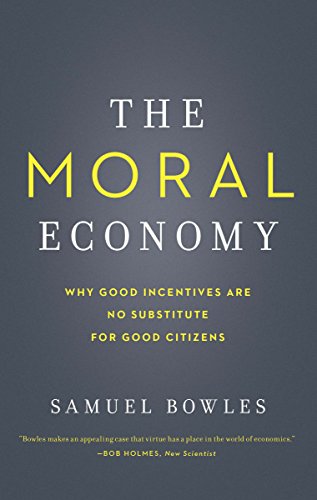
The moral economy: why good incentives are no substitute for good citizens
Material type: TextPublication details: New Haven and London Yale University Press 2016Description: xvi, 272p. Includes appendixes, notes, works cited and indexISBN:
 - 9780300230512
- X0aZ Q6
 Textbook
| Cover image | Item type | Current library | Home library | Collection | Shelving location | Call number | Materials specified | Vol info | URL | Copy number | Status | Notes | Date due | Barcode | Item holds | Item hold queue priority | Course reserves | |
|---|---|---|---|---|---|---|---|---|---|---|---|---|---|---|---|---|---|---|
|
Textbook
|
Ratan Tata Library | Ratan Tata Library | X0aZ Q6 (Browse shelf(Opens below)) | Available | RT1528384 |
Should the idea of economic man—the amoral and self-interested Homo economicus—determine how we expect people to respond to monetary rewards, punishments, and other incentives? Samuel Bowles answers with a resounding “no.” Policies that follow from this paradigm, he shows, may “crowd out” ethical and generous motives and thus backfire.
But incentives per se are not really the culprit. Bowles shows that crowding out occurs when the message conveyed by fines and rewards is that self-interest is expected, that the employer thinks the workforce is lazy, or that the citizen cannot otherwise be trusted to contribute to the public good. Using historical and recent case studies as well as behavioral experiments, Bowles shows how well-designed incentives can crowd in the civic motives on which good governance depends.
There are no comments on this title.