
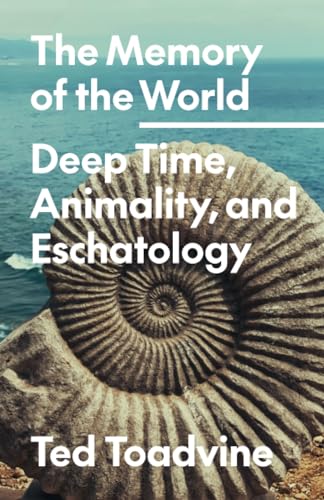
The memory of the world: Deep time, animality, and eschatology
Material type: TextLanguage: English Series: Posthumanities ; 70Publisher: [2024]Description: xiv, 329p.; 22 cmContent type:
 - text
- unmediated
- volume
- 9781517916008
- 9781517915995
- R39(S) R4
 Textbook
| Cover image | Item type | Current library | Home library | Collection | Shelving location | Call number | Materials specified | Vol info | URL | Copy number | Status | Notes | Date due | Barcode | Item holds | Item hold queue priority | Course reserves | |
|---|---|---|---|---|---|---|---|---|---|---|---|---|---|---|---|---|---|---|
|
Textbook
|
Central Library | Central Library | R39(S) R4 (Browse shelf(Opens below)) | Available | CL1682120 |
Includes bibliographical references (pages 293-317) and index.
"The Memory of the World argues for a new philosophy of time that takes seriously the multiple, pleated, and entangled temporal events spanning cosmic, geological, evolutionary, and human durations. Ted Toadvine contends that our obsession with the world's precarity relies on a flawed understanding of time that neglects the past and present with the goal of managing the future, misleading sustainability efforts and diminishing our encounters with the world and with human and nonhuman others"-- Provided by publisher.
"Advancing a phenomenological approach to deep time Our imagination today is dominated by the end of the world, from sci-fi and climate fiction to actual predictions of biodiversity collapse, climate disruption, and the emergence of the Anthropocene. This obsession with the world's precarity, The Memory of the World contends, relies on a flawed understanding of time that neglects the past and present with the goal of managing the future. Not only does this mislead sustainability efforts, it diminishes our encounters with the world and with human and nonhuman others. Here, Ted Toadvine takes a phenomenological approach to deep time to show how our apocalyptic imagination forgets the sublime and uncanny dimensions of the geological past and far future. Guided by original readings of Maurice Merleau-Ponty, Emmanuel Levinas, Jacques Derrida, Jean-Luc Nancy, and others, he suggests that reconciling our embodied lives with the memory of the earth transforms our relationship with materiality, other forms of life, and the unprecedented future. Integrating insights from phenomenology, deconstruction, critical animal studies, and new materialism, The Memory of the World argues for a new philosophy of time that takes seriously the multiple, pleated, and entangled temporal events spanning cosmic, geological, evolutionary, and human durations. "-- Provided by publisher.
There are no comments on this title.