
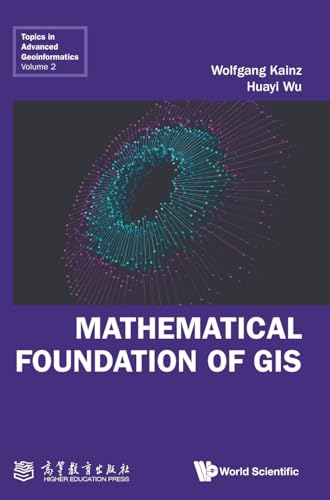
Mathematical foundation of GIS
Material type: TextLanguage: English Series: Topics in advanced geoinformatics ; Volume 2Publication details: Singapore: World Scientific, 2024.Description: xviii, 210p. : ill. ; 25 cmISBN:
 - 9789811292873
- U:(9S) R4
 Textual
| Cover image | Item type | Current library | Home library | Collection | Shelving location | Call number | Materials specified | Vol info | URL | Copy number | Status | Notes | Date due | Barcode | Item holds | Item hold queue priority | Course reserves | |
|---|---|---|---|---|---|---|---|---|---|---|---|---|---|---|---|---|---|---|
|
Textual
|
Central Science Library | Central Science Library | U:(9S) R4 (Browse shelf(Opens below)) | Available | SL1656064 |
Includes bibliographical references and index.
"Geographic Information Systems (GIS) originated in the 1960s and have since become the primary tool and science for handling spatial data. This unique compendium introduces essential mathematical knowledge related to GIS, including mathematical logic, geometry, algebra, topology, set theory, graph theory, probability theory and statistics, as well as uncertainty theory. These topics cover GIS data modeling, geometric calculations, topological analysis, spatial inference, and are helpful in understanding how to express spatial feature models, derive logical conclusions from given facts, perform coordinate transformations, and even aspects such as remote sensing image classification and machine learning"-- Provided by publisher.
There are no comments on this title.