
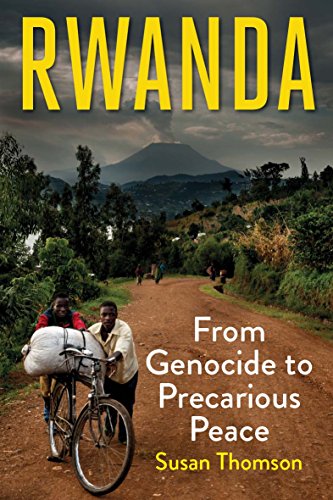
Rwanda : From Genocide to Precarious Peace / Susan Thomson.
Material type: TextPublisher: New Haven : Yale University Press, 2018Copyright date: ©2018Description: xv, 321 pages, 8 unnumbered pages of plates : illustrations, maps ; 25 cmISBN:
 - 9780300197396
- From genocide to precarious peace
 Textual
| Cover image | Item type | Current library | Home library | Collection | Shelving location | Call number | Materials specified | Vol info | URL | Copy number | Status | Notes | Date due | Barcode | Item holds | Item hold queue priority | Course reserves | |
|---|---|---|---|---|---|---|---|---|---|---|---|---|---|---|---|---|---|---|
 Textbook
|
Department of African Studies Library | Department of African Studies Library | Available | AS0003105 |
Includes bibliographical references and index.
Introduction : The "New" Rwanda -- Part I. Genocide, and Its Causes and Consequences. Genocide : Power Politics, not Ethnic Hatred -- The Roots of the Genocidal State -- Refugee Rebels : Preparing for Civil War -- Part II. Transitioning to Peace?. A Semblance of Normality -- Securing People and Place -- Control at Home and Abroad -- Militarized Democracy -- Part III. Setting Up for Success. State, Party, Family -- Good Citizens -- Conformity or Else -- Part IV. The Fruits of Liberation. Rules, Rules and More Rules -- Friends Only -- Epilogue : The Politics of "Never Again".
A sobering study of the troubled African nation, both pre- and post-genocide, and its uncertain future The brutal civil war between Hutu and Tutsi factions in Rwanda ended in 1994 when the Rwandan Patriotic Front came to power and embarked on an ambitious social, political, and economic project to remake the devastated central-east African nation. Susan Thomson, who witnessed the hostilities firsthand, has written a provocative modern history of the country, its rulers, and its people, covering the years prior to, during, and following the genocidal conflict. Thomson's hard-hitting analysis explores the key political events that led to the ascendance of the Rwandan Patriotic Front and its leader, President Paul Kagame. This important and controversial study examines the country's transition from war to reconciliation from the perspective of ordinary Rwandan citizens, Tutsi and Hutu alike, and raises serious questions about the stability of the current peace, the methods and motivations of the ruling regime and its troubling ties to the past, and the likelihood of a genocide-free future.
There are no comments on this title.